Why Jalapeño Is OpenAI’s Profitability Play, Not a Chip Story

OpenAI’s first custom inference chip is a declaration that the part of the AI stack touching every user must eventually belong to the model-maker, not the GPU vendor.

Broadcom CEO Hock Tan handing the first Jalapeño AI inference chip to OpenAI leaders at the June 2026 unveiling (Photo: TechCrunch / OpenAI)

On June 24, Hock Tan, Broadcom’s chief executive, physically handed a slab of silicon to Sam Altman and Greg Brockman. The chip is called Jalapeño, and the temptation is to file it under hardware — another reticle-sized ASIC, another 3nm tape-out at TSMC, another entry in the arms race of accelerators. That framing misses the point entirely. Jalapeño is a financial document disguised as a piece of engineering. It is the first hard evidence of how OpenAI intends to stop losing money.

Consider the backdrop. OpenAI’s leaked 2025 statements show an operating loss of $20.9 billion on $13.1 billion in revenue, with total costs of $34 billion and cost of revenue alone at $7.5 billion. The company has told investors its compute spending could reach roughly $600 billion through 2030, against a 2030 revenue target it now pegs at more than $280 billion — a gap that has fed mounting questions about whether it can ever earn enough to cover its costs. A meaningful slice of that cost of revenue is the margin Nvidia extracts from every inference pass — every token of every ChatGPT answer. Jalapeño is OpenAI’s bet that this margin is not a law of nature but a tax it can stop paying.

The inference layer is where the money leaks

The crucial distinction in the announcement is one most coverage glosses over: Jalapeño targets inference, not training. Nvidia, which still dominates the market for AI chips, owns the capital-intensive, infrequent work of building a model. Inference is the opposite — the recurring, high-volume work of running it. Training happens a few times a year; inference happens billions of times a day. It is the part of the stack that touches every user, every query, every minute. And it is therefore the part where a few cents of cost-per-token, multiplied across a planetary user base, decides whether a frontier lab is a business or a bonfire.

OpenAI hardware lead Richard Ho was explicit that the chip was optimized around the kernels, memory movement, and serving patterns that matter most for frontier models, with Tan claiming it matches Nvidia’s Blackwell and Google’s TPUs on speed and efficiency for large language models. Treat any such comparison skeptically — these are vendor figures, on early silicon, under conditions OpenAI controls, and they elide total cost of ownership, yields, and the software ecosystem Nvidia’s CUDA moat still commands. But even heavily discounted, the strategic logic holds. When inference is the dominant and growing line item, shaving its unit cost is not an optimization. It is the difference between a gross margin that compounds and one that bleeds.

Owning the workload, not renting it

Brockman framed Jalapeño as part of OpenAI’s full-stack infrastructure strategy to make compute more abundant, noting the company had been hunting for “specific workloads that are underserved.” Strip the diplomacy and the message is sharper: a general-purpose GPU is, by definition, a compromise. It must serve every customer’s workload, so it is optimal for none. OpenAI knows precisely what its models do at inference time, and a chip built only for that has no transistors to waste on flexibility it will never use. That the chip was, by OpenAI’s account, designed end to end in nine months — accelerated by the company’s own models — is itself the argument: vertical integration collapses the distance between knowing the workload and shaping the silicon.

What makes this an industry-fracturing moment rather than a one-company quirk is the company doing it. Google has its TPU, Amazon its Trainium, Apple and SpaceX their own silicon — but each sits atop a cloud or device business that subsidizes the chip program. OpenAI is the first pure-play AI software company, with no infrastructure business of its own, to build a custom AI chip. There is no hyperscaler balance sheet underneath it. That raises the stakes and clarifies the thesis: for a standalone AI company, custom silicon is not a luxury but the hidden prerequisite for ever turning a profit. Every frontier lab that does not own its inference hardware is, in effect, subsidizing its chipmaker’s margin — and may eventually find that the only way to afford compute is to be absorbed into a cloud hyperscaler that already owns the chips.

A fault line, not a knockout

The structure of the partnership underlines the independence story. When OpenAI and Broadcom went public with their 10-gigawatt custom-chip pact in October 2025, financial terms were not disclosed — but the logic was plain: by designing its own chips, OpenAI could bring compute costs down and stretch its infrastructure dollars further. That distinguishes it in spirit from OpenAI’s entanglements with Nvidia, which pledged up to $100 billion to OpenAI in a buildout where the chipmaker is both supplier and investor. Broadcom builds the silicon; OpenAI owns the architecture and the margin it unlocks. Tan, for his part, described demand from Broadcom’s frontier-lab customers as “insatiable,” with Jalapeño slated for prototype deployment in late 2026 and a real ramp in 2027 and 2028.

None of this kills Nvidia. Training remains its fortress, CUDA remains sticky, and a single first-generation chip from one customer dents nothing in the near term — Broadcom’s shares climbed only modestly on the day. The honest read is more interesting than a death notice. Jalapeño marks the moment the industry’s economics visibly split along a chip-sovereignty fault line: labs that will own their inference silicon and have a credible path to profit, and labs that will rent it and forever hand the richest, most recurring slice of their economics to someone else. The AI business has spent three years arguing about model quality. The next argument — the one that decides who survives as a standalone company — is about who owns the chip that answers the question.

This article is a guest contribution. For ongoing tech coverage and analysis, visit Karsane.

About Karsane — Karsane is an independent daily covering world news, business, U.S. politics, the economy, markets, technology, health and sports. Read more at karsane.com.

What is Github Copilot and How to Use it

In this tutorial, you will learn about the revolutionary AI tool GitHub Copilot, including what it is and what you can do with it.

GitHub Copilot is an AI tool that helps coders write code faster and with fewer bugs. It assists in multiple ways, including code completion and suggestions, error fixing and debugging, code refactoring, optimization, and more.

GitHub Copilot is available for anyone to use with Free. We can easily use it by installing the extension in our IDEs like Visual Studio Code or any other, signing in to GitHub, and then starting to code; Copilot will then provide suggestions as we type or ask questions via chat.

(more…)

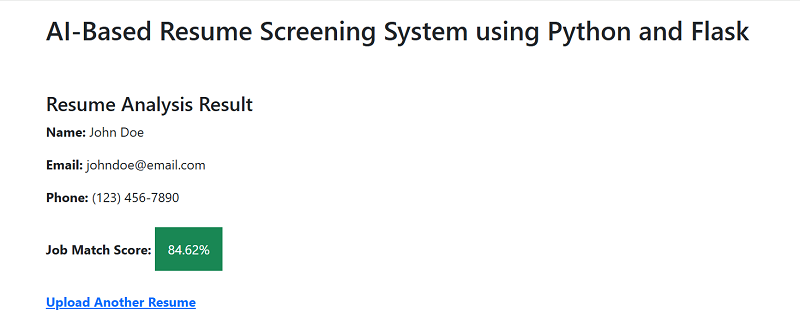
AI-Based Resume Screening System using Python and Flask

In this tutorial, we will develop an AI-Based Resume Screening System using Machine Learning to help recruiters.

Large companies receive thousands of job applications every month. Manually reading and selecting suitable resumes is time-consuming. What if we build an AI system to automate this process, automatically shortlisting the best candidates for interviews based on their resume details?

So here, we will develop an AI-based resume screening system to automate resume analysis and shortlist candidate based on job description, skills matching score.

(more…)

Create REST API Using FastAPI, Python & MySQL

In our previous REST API tutorial, we have explained to create a REST APIs using Python and MySQL. In this tutorial, we will create REST APIs using FastAPI.

We will create REST API with common CRUD functions like getting data, insert new data, update and delete data.

What is REST API?

A RESTful API, or REST API is an application interface that enables applications to communicate with each other by using
HTTP requests with methods (GET, POST, PUT, DELETE) to access and use data. They are commonly used in web and mobile applications.

What is FastAPI?

FastAPI is a high-performing modern web framework for building APIs quickly with Python. The framework is develoed to be easy to use, efficient, and reliable. These features makes it a first choice for developing RESTful APIs and web applications. (more…)

AWS S3 File Upload using Python and Flask

In our previous Python project tutorial, we have developed Discussion Forum using Flask and Python. In this tutorial, we will build an app to upload files to AWS S3 using Python and Flask.

Amazon Web Services (AWS) is provides on demand cloud services for hosting websites and storing files. The AWS S3 (Simple Storage Service) is a cloud storage service from AWS that offers simple, scalable, cost-effective and secure to store files. It provides feature to create buckets to store files and called objects.

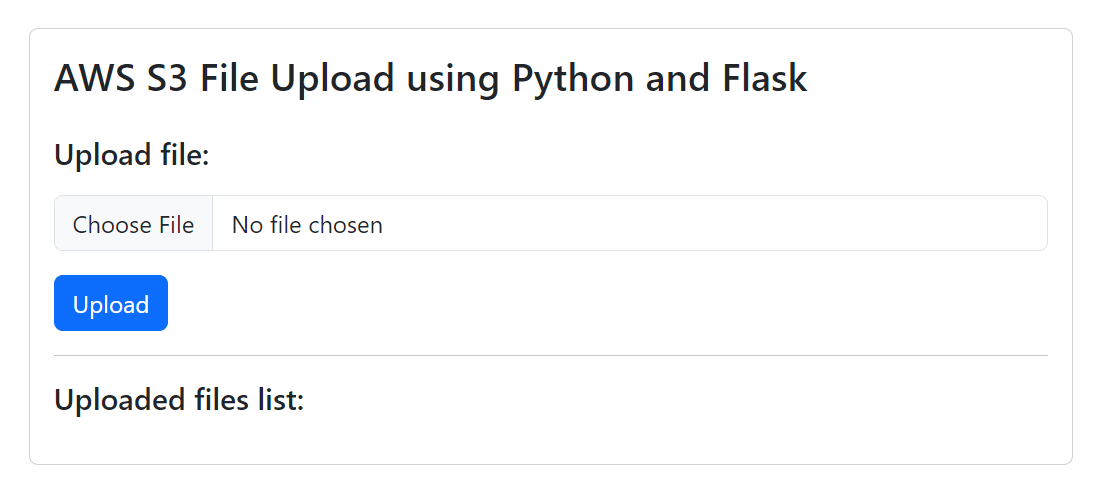
So here in this tutorial, we will develop a flask based application to upload files to AWS S3 server. We will implement functionality to upload files to AWS S3 buckets using Python. We will use boto3 module from Python to upload files. (more…)